
Application 3 / 5
Industrial Binder
Sodium humate is the water-soluble sodium salt of humic acid. Besides agriculture and feed, it is used as a binder for coal, coke and metal powder, for example in briquetting. Refined super sodium humate is also used as a mud adjuster in oil drilling.
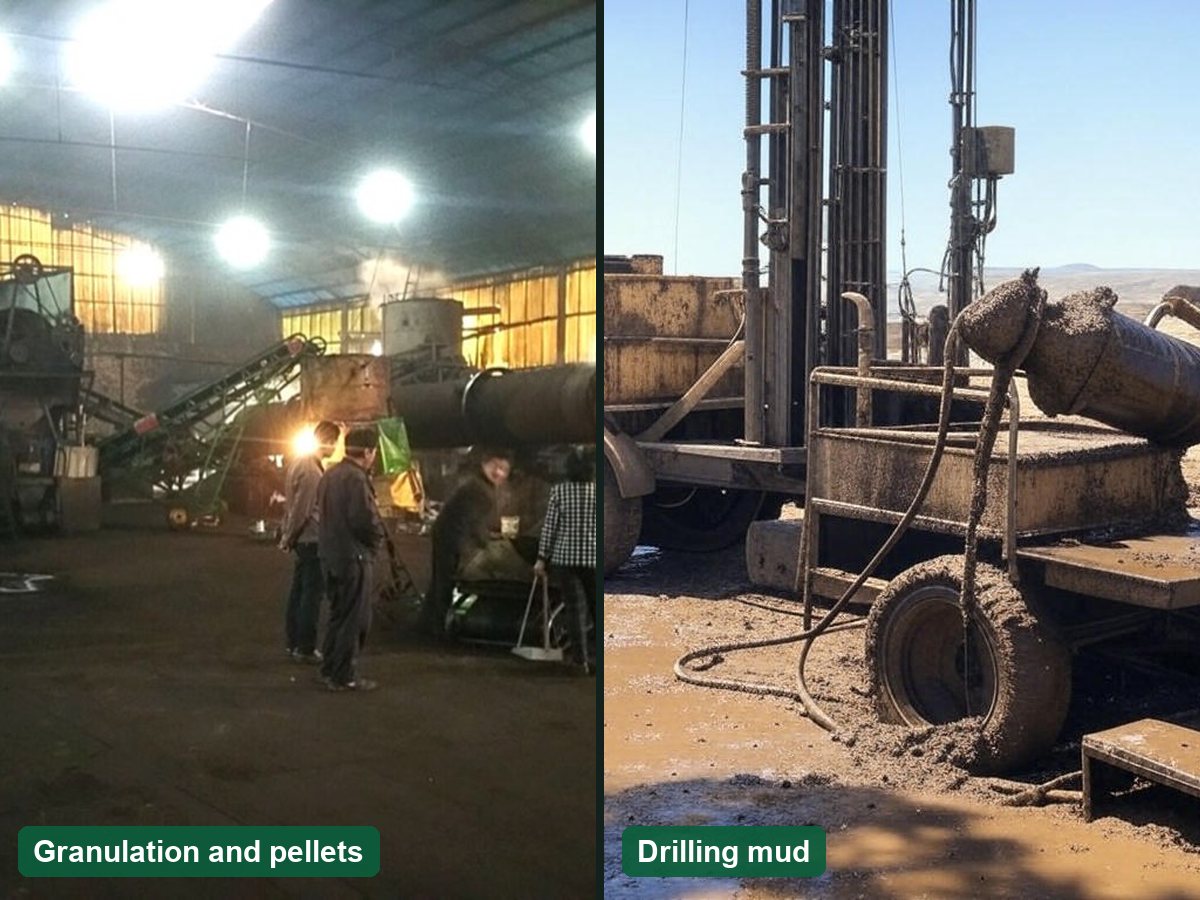
Four uses
Where humate binders are used
Coal and coke briquettes
Coal fines and coke breeze are difficult to handle, store and burn as they are. Briquetting presses them, together with a binder, into lumps of uniform size that can be stored, transported and used like lump fuel or as a reductant. Sodium humate is dissolved in water and mixed with the fines before pressing; as the briquettes dry, the humate forms bonds between the particles. It is used alone or combined with other binders, and the addition rate, mixing moisture and drying conditions are set by trial for each coal or coke.
What to test
- Green and dried strength (drop and compressive tests)
- Water resistance of the dried briquette
- Behaviour of the briquette on heating
Metal powder agglomeration
Fine ore concentrates, mill scale and metallurgical dusts are agglomerated into pellets or briquettes so that they can be recycled or charged into furnaces. Humic-substance binders have been studied as organic binders in iron ore pelletizing, alone or as a partial replacement for bentonite: the organic part burns off during firing, so less silica and alumina are added to the pellet. Suitability depends on the ore, the agglomeration process and the firing conditions, and has to be confirmed by tests.
What to test
- Green ball strength and drop number
- Dry and fired pellet strength
- Sodium input to the furnace burden
Fertilizer pellets
In granulated and pelleted fertilizers, a soluble humate can act as a binder that helps granules form and hold together through drying, handling and storage. Because the binder is itself a humic substance, it also adds humic acid to the product; how it is declared follows the fertilizer rules of the destination market.
What to test
- Granule crushing strength, dust and abrasion
- Compatibility with the fertilizer salts, calcium and acidity of the formula
- Moisture of the finished granules
Oil drilling mud
In water-based drilling fluids, humate-based products are used as mud conditioners. They act as thinners (deflocculants) that help control viscosity and gel strength, and they contribute to filtrate (fluid-loss) control, including at elevated temperatures. Refined super sodium humate is the grade used for this purpose. Drilling-fluid additives have to meet the operator’s specifications and the environmental rules that apply to the well.
What to test
- Solubility and insoluble residue
- Effect on viscosity and filtrate loss in the mud
- Temperature stability and compatibility with other mud additives
What to check
- Water solubility and insoluble matter
- Moisture and particle size
- Humic acid content and its test basis (see the product TDS)
- Compatibility with your other binders and your process
Testing a humate binder?
Tell us the material, the process and the strength you need; we reply with a grade and its TDS.